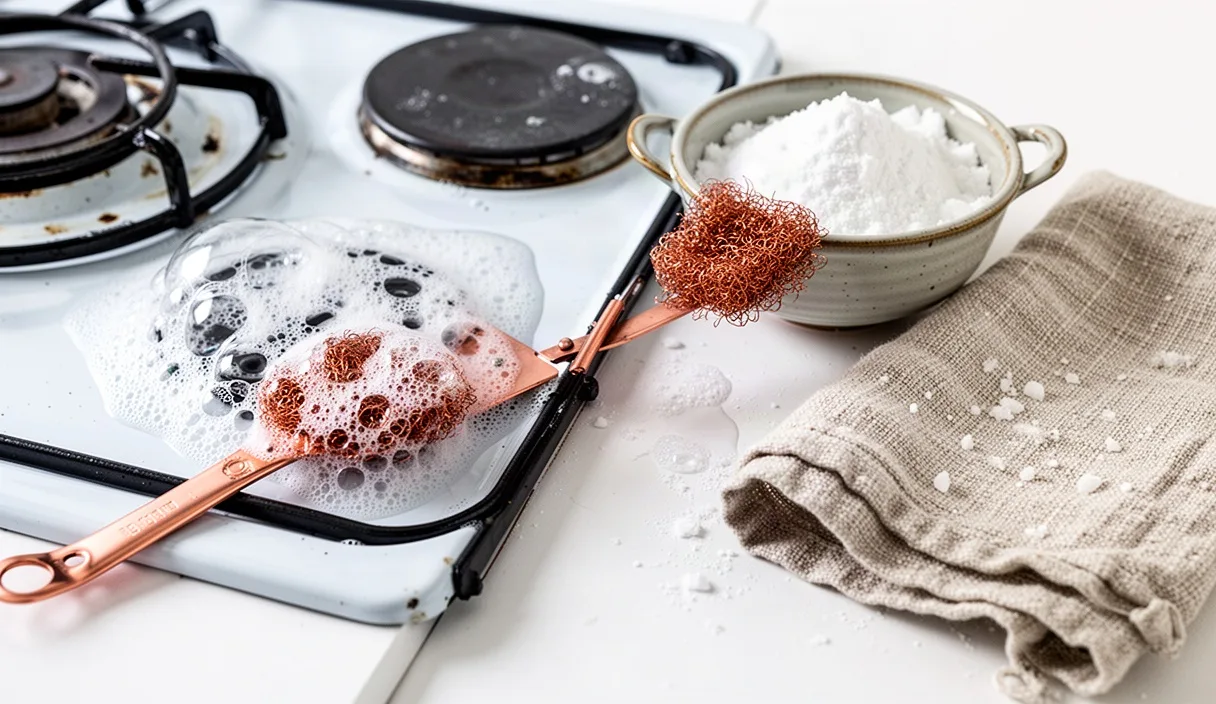
When heavy linen arrives at our worktables from the loom or an estate chest, it often carries a board-like stiffness. A dense plain weave or twill, cut from flax yarns weighing 380 to 450 grams per square meter, does not yield immediately to the hand. Its surface feels raw, textured with slubs and chaff, and unyielding across the bias. Many people reach instinctively for chlorine bleach or chemical softeners to break down this recalcitrance, believing that harsh oxidizers and silicone coatings are the only ways to tame coarse yards of cloth. In doing so, they strip the fabric of its fundamental character and drastically shorten its working life.
We approach heavy linen through the older discipline of the wash house: water volume, controlled mechanical movement, neutral soaps, and patient drying. Bleach degrades the very polymers that give flax its legendary endurance, leaving the fibers brittle and prone to split along crease lines. To soften heavy cloth without compromising its core strength, we must understand how the individual bast fibers respond to moisture and friction. Through quiet, rhythmic washing methods, we can transform stiff harness linen into a supple, drapeable textile that retains its substantial weight for decades.
Flax Fiber Anatomy and Resistance to Abrasion
Flax is a bast fiber harvested from the stem of Linum usitatissimum. Unlike cotton, which grows as a single, rounded seed hair, flax consists of bundles of elongated, polygonal cells bonded together by natural plant pectins and hemicellulose. These individual filaments are composed of roughly 70 to 75 percent crystalline cellulose, aligned in long, parallel microfibril spirals. Along the length of each fiber sit microscopic nodes or cross-markings. These nodes serve as tiny hinges, giving flax its unique structural character: immense tensile strength in the direction of the yarn, paired with a distinct resistance to sharp lateral bending.
The stiffness in newly woven heavy linen comes from two primary sources: the residual pectins that glue the cellular bundles together, and the sizing applied to the warp yarns during weaving to withstand loom tension. In commercial finishing, aggressive chemical baths dissolve these pectins rapidly, which causes the fiber bundles to splinter prematurely. When we rely instead on water and gentle, repetitive movement, the cellulose chains gradually relax and separate at their surface without fracturing the inner bundle. The nodes begin to flex repeatedly, allowing the rigid yarns to settle into their weave crimp.
Chlorine bleach attacks this anatomy directly through oxidation. Sodium hypochlorite cleaves the beta-glucosidic bonds of the cellulose chains, converting strong primary hydroxyl groups into fragile carboxyl and carbonyl groups. The fabric appears softer initially, but this softness is the result of fiber thinning and structural decay. Heavy flax has high natural resistance to wet friction, meaning we can safely agitate the cloth in clean water to flex its nodes, provided we do not introduce chemical agents that chew through the polymer backbone.
Soap Choices for Neutral pH Laundering
The chemical environment of the wash water dictates whether linen fiber bundles remain pliable or dry out into needle-sharp threads. Cellulose tolerates mild alkalinity, but heavy concentrations of free alkalis, common in heavy-duty commercial detergents and washing sodas, strip the lingering wax and pectin matrix entirely. Conversely, strongly acidic solutions weaken cellulose chains. We aim for a wash bath with a neutral pH between 6.5 and 7.8, which protects the fiber core while lifting surface oils and workshop dust.
Liquid soaps derived from plant saponins or saponified olive and potassium-based oils are our preferred agents. Hard-milled sodium soaps can leave insoluble curds in hard water that deposit inside the dense weave, turning the linen chalky and stiff as it dries. A pure potassium cocoate or olive castile liquid disperses evenly through heavy yardage without clinging to the micro-crevices between the warp and weft. If modern synthetic liquid detergents are used, they must be free of optical brighteners, synthetic enzymes that digest vegetable starches, and added fragrances that leave oily residues.
| Cleaning Agent | Working pH Range | Residue Risk | Suitability for Heavy Linen |
|---|---|---|---|
| Liquid Olive Castile | 7.2 to 7.8 | Low in soft water, moderate in hard water | Optimal for traditional hand soaking and gentle tubs |
| Potassium Cocoate Soap | 7.0 to 7.5 | Low | Excellent for general agitation baths |
| Commercial Heavy-Duty Powder | 9.5 to 11.0 | High, binds with mineral salts | Poor, induces long-term fiber embrittlement |
| Enzymatic Liquid Detergent | 6.8 to 8.2 | Moderate | Use with caution, avoid cellulase-containing formulas |
A note on water hardness: if your water contains high levels of dissolved calcium and magnesium (above 120 parts per million), soap will bind with these minerals to form lime curd. In such cases, add two tablespoons of dissolved sodium citrate per ten liters of wash water. Sodium citrate acts as a gentle chelating agent, capturing the mineral ions without swinging the pH into corrosive ranges, allowing the soap to rinse away completely from the interior of dense yarns.
Softening Stiff Weaves Through Water Agitation
The primary mechanism for softening heavy linen without chemical additives is the mechanical working of wet fibers against one another. When flax absorbs water, the fibers swell by roughly 15 to 20 percent in diameter, while shrinking slightly in length. This swelling pushes the yarn intersections against each other, building internal hydrostatic pressure. Agitating the fabric while it is fully saturated forces the swollen yarns to slide, rubbing off the outermost stiffening pectins and rounding the edges of the woven grid.
To achieve this at home, volume is critical. Heavy linen cannot be crowded into a water-stingy wash basket. If you use a machine, select an oversized load setting with an extra-deep rinse, maintaining a liquor ratio of at least one part dry fabric to ten parts water by weight. If washing by hand in a basin or wash tub, work with single panels or pairs of towels at a time.
The Tub Agitation Sequence
- Initial Hydration: Submerge the dry linen in lukewarm water (between 30 and 40 degrees Celsius) for four hours without soap. This allows the inner lumen of the flax fibers to absorb moisture uniformly before any mechanical stress is applied.
- First Working: Dissolve 30 milliliters of neutral liquid soap in the tub. Knead the fabric firmly with your fists, compressing and unfolding the yardage for twelve to fifteen minutes. The sensation should resemble kneading stiff rye dough; avoid twisting or wringing the fabric.
- The Sinking Paddle: Using a smooth, broad ash or maple laundry paddle, press down upon the fabric bundle against the bottom of the tub, lifting and turning the folded cloth after every five downward strokes. The goal is to force wash liquor rapidly through the interstitial spaces of the weave.
- Water Exchange: Drain the soapy liquor entirely. Refill with cool, clean water at roughly 20 degrees Celsius. Compress and agitate for six minutes to rinse. Repeat this fresh-water rinse twice more until the water remains clear and free of foam.
If you prefer mechanical assistance, run the soaked linen through a front-loading machine set to a wool or delicate cycle with the spin speed capped at 400 revolutions per minute. Never subject heavy, wet linen to high-speed extraction spins of 1000 or 1200 revolutions per minute; the centrifugal force crushes the swollen, hinge-like nodes against the metal drum walls, imprinting sharp fold lines that can take months of laundering to erase.
Hanging Methods that Prevent Fold Creasing
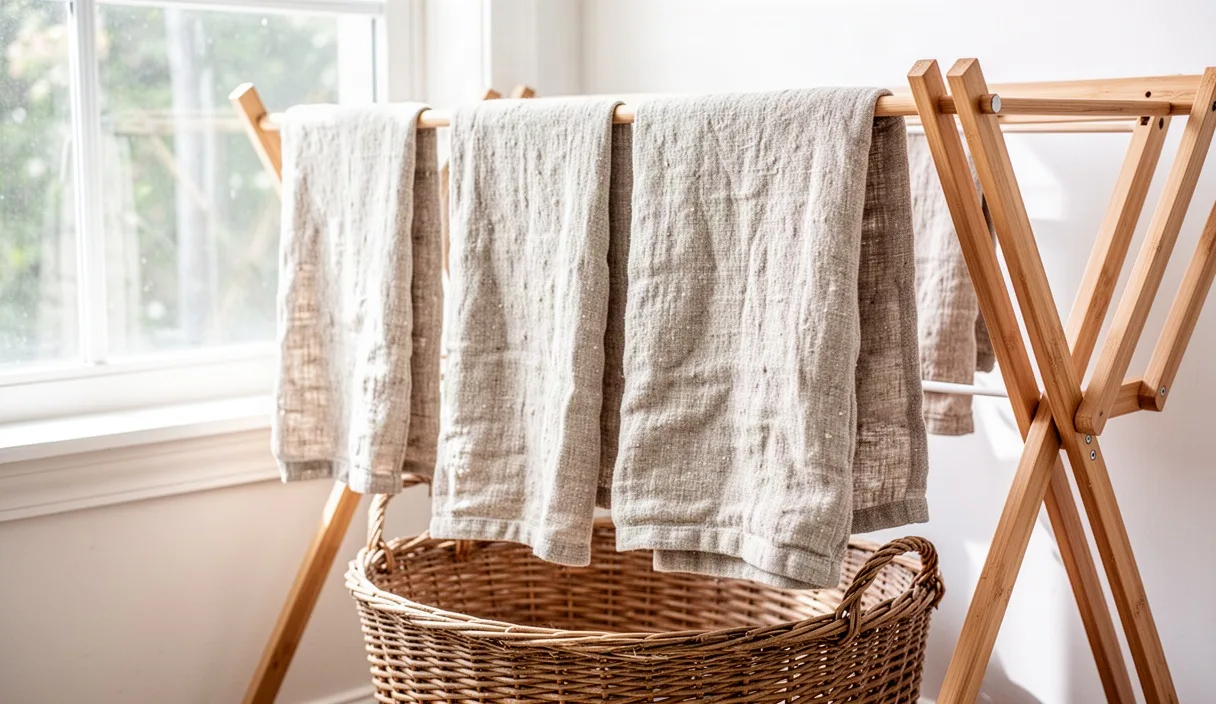
Wet linen has high plastic memory. As water evaporates from the cellulose matrix, hydrogen bonds re-form between adjacent polymer chains, locking the fibers into whatever spatial arrangement they hold at the moment of drying. If heavy linen dries over a thin wire or clamped in sharp clothespins, those sharp deflections become semi-permanent set marks that resist even hot steam pressing. We must use drying arrangements that distribute the fabric's substantial wet weight across broad, curved surfaces.
The most effective drying frame is a turned hardwood dowel or a smooth copper pipe with a diameter of at least 35 millimeters. Clean the timber or metal surface thoroughly before draping the textile. Spread the fabric out so that half the weight hangs on each side of the dowel, balancing the panels precisely. By eliminating clothes pegs, you prevent concentrated pinch points where the dense weft yarns would otherwise distort around a spring-loaded jaw.
While the linen is still wet and heavy on the dowel, take the bottom corners in both hands and snap the fabric downward with a firm, sharp movement. Follow this by running your palms down the vertical selvedges, drawing the fabric taut along its warp grain. This action pulls the wet crimp straight and encourages gravity to pull out any surface ripples before the drying front moves through the cloth. Position the rack in a breezy, shaded outdoor spot or in a room with open windows and cross-ventilation. Keep heavy linen out of intense midday sunlight, as unbuffered ultraviolet rays degrade moist natural fibers just as rapidly as commercial chemicals.
If you must dry your linen indoors during colder months, monitor the ambient temperature. Slow drying in a cold, stagnant room invites mildew inside the damp core of dense yarn bundles. Use a small floor fan running on low speed to keep air circulating beneath the hanging folds, ensuring that drying concludes within eight to ten hours of exiting the rinse water.
Storing Folded Linens in Breathable Spaces
Once heavy linen has dried to room equilibrium, its moisture content hovers around eight to twelve percent. The cellulose structure requires this bound moisture to remain supple. Storing heavy linen in airtight plastic tubs or vacuum-sealed bags suffocates the textile, trapping micro-condensation that encourages mold growth and causing the flax to dry out unevenly, which restores its unyielding stiffness. The storage environment must breathe, filtering dust while permitting seasonal humidity exchanges.
We wrap our washed and rested linens in unbleached, desized cotton muslin, or slip them into plain linen pillowcases. These natural outer sleeves protect the interior cloth from surface soot and light exposure while allowing ambient air to move freely through the grain. If you must use wooden storage chests, avoid green oak, cedar, or raw pine that contains volatile organic acids and terpenes; these plant resins off-gas over time and scorch yellow streaks into folded bast fibers. Line wooden drawers with sheets of acid-free, unbuffered tissue paper to form a barrier between the timber and the fabric.
Refold your heavy linens twice each year along alternate lines. Because the yarns are thick and packed closely, constant pressure along a single crease weakens the cellulose nodes at the outer curve of the fold. By simply shifting the fold by five centimeters or rolling the yardage around a cardboard mailing tube lined with tissue, you relieve the mechanical tension and keep the entire length uniformly supple.
Common Mistakes to Avoid
Softening heavy linen is a subtractive and physical process rather than an additive one. Deviating from simple routines can introduce damage that takes extensive restoration to correct.
- Applying Commercial Fabric Softeners: Liquid conditioners coat the flax fibers with hydrophobic quaternary ammonium compounds. This kills the fabric's natural capacity to absorb water and attracts dirt into the dense weave, making the cloth feel greasy rather than soft.
- Overdrying in Heated Tumble Dryers: While a brief ten-minute tumble on cool or air-fluff with three heavy wool balls can help break initial line stiffness, running heavy linen through a full heat cycle bakes the moisture out of the cell lumens, turning the yarns brittle and chalky.
- Using Vinegar as a Regular Rinse Agent: While an occasional splash of dilute white vinegar can clear soap residue in hard water areas, habitual acid rinses lower the pH of the wet cloth below 5.5, accelerating the breakdown of crystalline cellulose over prolonged periods.
- Ironing Bone-Dry Cloth: A dry, hot iron skids across heavy linen, flattening the outer yarns into a synthetic-looking sheen without relaxing the weave. Heavy linen should always be ironed while noticeably damp, or pressed solely with steam.
Your Next Steps
To begin softening a piece of rigid heavy linen, set aside an afternoon for a foundational wash rather than rushing the cloth through a mixed laundry cycle. Prepare a deep tub or basin with eighteen to twenty liters of lukewarm water, letting the dry cloth drift down into the bath under its own weight without forcing it into tight wads.
Allow the fabric to rest submerged until the yarns darken evenly and the water penetrates to the core of the weave. Work the yardage with a steady rhythm of compression, lifting, and water exchanges using your hands or a broad wooden paddle. Once rinsed, drape the saturated cloth over a wide support away from direct heat. If the piece is an irreplaceable antique or shows signs of existing fiber breakage along old folds, consider consulting a professional textile conservator before undertaking aggressive water agitation.