In our kitchens, few tasks reward patient attention quite like the extraction of stock from remnants that others might discard. When we roast whole chickens through the colder months, we save every frame, wing tip, and neck bone in parchment-lined bins within the freezer. Accumulating three or four carcasses over several weeks gives us the raw material for a broth that holds body, clarity, and deep savory resonance. A clear stock is not born of luck or modern chemical fining; it comes from an honest understanding of collagen, temperature control, and the mechanical behavior of suspended solids in water.
The distinction between a cloudy, turbulent broth and a pristine, glass-clear chicken stock lies entirely in the handling. Violent boiling pulverizes bone matter and emulsifies rendered fat into the water column, creating an irreversible opacity. By treating our saved frames with deliberate heat, balancing our water weights, and skimming with regular devotion, we tease out gelatin without disturbing the water. The result is a golden liquor that sets to a firm jelly in the icebox and melts cleanly across the tongue, ready to anchor sauces, braises, and grain dishes.
Roasting and Prepping Bones for Gelatin Extraction
Before any water touches the pot, we must evaluate the state of our saved bones. Carcasses gathered from previous family meals have already undergone initial cooking, but their collagen reserves remain locked within the dense matrix of joints and cartilage. We break down the whole carcasses by hand or with heavy kitchen shears. Snapping the backbone into three pieces and separating the pelvic joints exposes the marrow and increases surface area, allowing water to reach the inner surfaces where soluble proteins live.
If the carcasses came from poached or lightly steamed poultry, they benefit from an introductory dry roast. We lay the cracked bone pieces across a heavy steel sheet pan, ensuring they do not crowd or overlap. A furnace temperature of 400 degrees Fahrenheit for 28 to 32 minutes browns the outer skin scraps and residual meat without charring the calcium framework. Darkened caramelization brings deep color, but deep black carbon will introduce a bitter taste and grey cast to the liquor. If the birds were already dark-roasted rotisserie frames, we skip the secondary oven roast and go straight to the pot to avoid over-toasting fragile fats.
Tendons and knuckle joints house the greatest density of type I and type III collagen, the precursors to gelatin. When raw wings, necks, or feet are available to supplement the saved roasted frames, we introduce them here. Feet and necks provide thick, structural viscosity without adding excessive browned pigment. We rinse any freezer crystals off the bones under cold running tap water for twenty seconds, washing away surface frost that carries stale freezer aromas, before placing the pieces into a heavy-bottomed eight-quart or twelve-quart stockpot.
Water Ratios and Vegetable Aromatics Selection
Water volume dictates whether a stock emerges thin and watery or unctuous and gelatinous. A common error is drowning bones in an ocean of water, which yields a weak liquid that demands hours of aggressive reduction later. We weigh our clean bones on a bench scale and apply a strict ratio: two parts water by weight to one part bones. For 1,500 grams of cracked chicken frames, we measure out exactly 3,000 grams of cold, filtered water. The cold start is mandatory. Pouring cold water over cold bones allows soluble proteins to dissolve gradually as the temperature rises, floating gently to the surface where they can be collected rather than coagulating instantly against the hot metal bottom.
Vegetable selection requires restraint. Stock should taste of roasted bird and clean minerality, not sweet root vegetables. We bypass turnips, parsnips, and brassicas entirely; parsnips introduce excessive sugar that clouds the liquor, while cabbage varieties leach sulfurous notes. We stick to an old ratio based on traditional mirepoix: two parts yellow onion, one part carrot, and one part celery rib by weight. For our 1,500 grams of bones, we use no more than 350 grams of total aromatics, sliced thick into two-inch chunks so they do not disintegrate during the extended heat exposure.
| Component | Weight for 1,500g Bones | Preparation Method | Role in Extraction |
|---|---|---|---|
| Cold Water | 3,000 grams | Filtered, chilled from tap | Dissolves albumens; provides extraction medium |
| Yellow Onion | 175 grams | Unpeeled skins, halved crosswise | Lends golden hue from skin; savory base |
| Carrot | 85 grams | Unpeeled, cut into 2-inch logs | Adds background earthiness without excess fructose |
| Celery Ribs | 90 grams | Leaves trimmed, cut into large segments | Provides natural sodium and herbal aroma |
| Herb Bouquet | 15 grams | Tied parsley stems, thyme sprigs, bay leaf | Subtle aromatic seasoning without loose particles |
We do not add our vegetables at the start of the extraction. Root vegetables soften and begin to break apart after roughly two hours of heat. Introducing them at the very beginning leads to cellular breakdown, which releases fine cellulose silt into the pot that no cloth can fully catch. We submerge the bones in water first, let them run through their initial clarification phase, and add the mirepoix and herb bundle only during the final two hours of the cook.
Managing the Sub-Simmer without Violent Bubbling
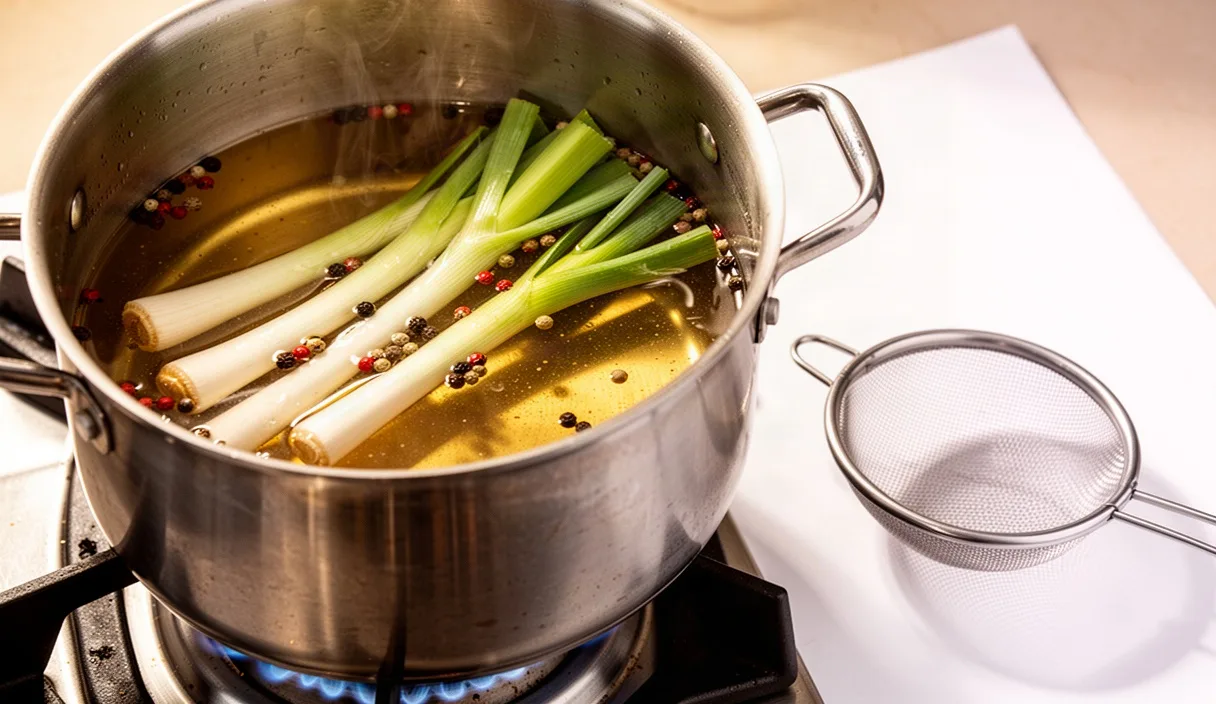
Thermal management is the single most critical factor for visual purity. We set the pot over a medium burner, allowing the temperature to climb slowly toward the threshold of protein coagulation, which happens around 140 to 160 degrees Fahrenheit. At this stage, we monitor the surface closely. When the liquid reaches 185 to 195 degrees Fahrenheit, tiny pinprick bubbles will rise occasionally near the outer rim of the pan, but the center should remain calm, forming a gently rolling convective current.
A rolling boil must never be permitted. Boiling water churns like a mechanical blender, violently smashing fat globules into microscopic droplets. When fat droplets collide with hot water and dissolved proteins, they form a stable emulsion, identical to what occurs when whisking an aioli or an emulsified vinaigrette. Once stock becomes emulsified with grease, it turns permanently milky and opaque. No amount of straining or cooling will ever restore transparency to an emulsion created by hard boiling.
To maintain this precise sub-simmer across four to six hours, we use physical heat diffusers when cooking on responsive gas ranges, or we shift the stockpot slightly off-center over an electric element. Off-setting the pot creates an asymmetric thermal convection: heat rises up one side, pushes across the top, and rolls gently downward along the opposite cooler wall. This circular movement carries impurities straight to one side of the surface, consolidating them in an easily accessible skim zone rather than scattering them across the entire perimeter.
Skimming Albumen and Surface Fats Patiently
During the first sixty minutes of warming, gray and white foam gathers across the surface of our pot. This material consists of albuminous proteins, primarily blood residues and water-soluble myoglobin that have denatured and risen under heat. We do not stir the pot. Stirring drives these fragile rafts back down into the depths, breaking them into tiny flecks that pepper the finished broth.
Instead, we arm ourselves with a shallow, fine-mesh skimmer or a broad metal ladle. Holding the bowl of the ladle parallel to the surface, we depress it just enough for the foam and gray scum to slip over the metal rim while leaving the clear liquid beneath undisturbed. We wipe the edge of the pot with a damp linen towel after each pass to remove dried scum rings that bake onto hot stainless steel. Skimming requires our continuous presence for the first thirty minutes, after which the rate of surface coagulation drops substantially.
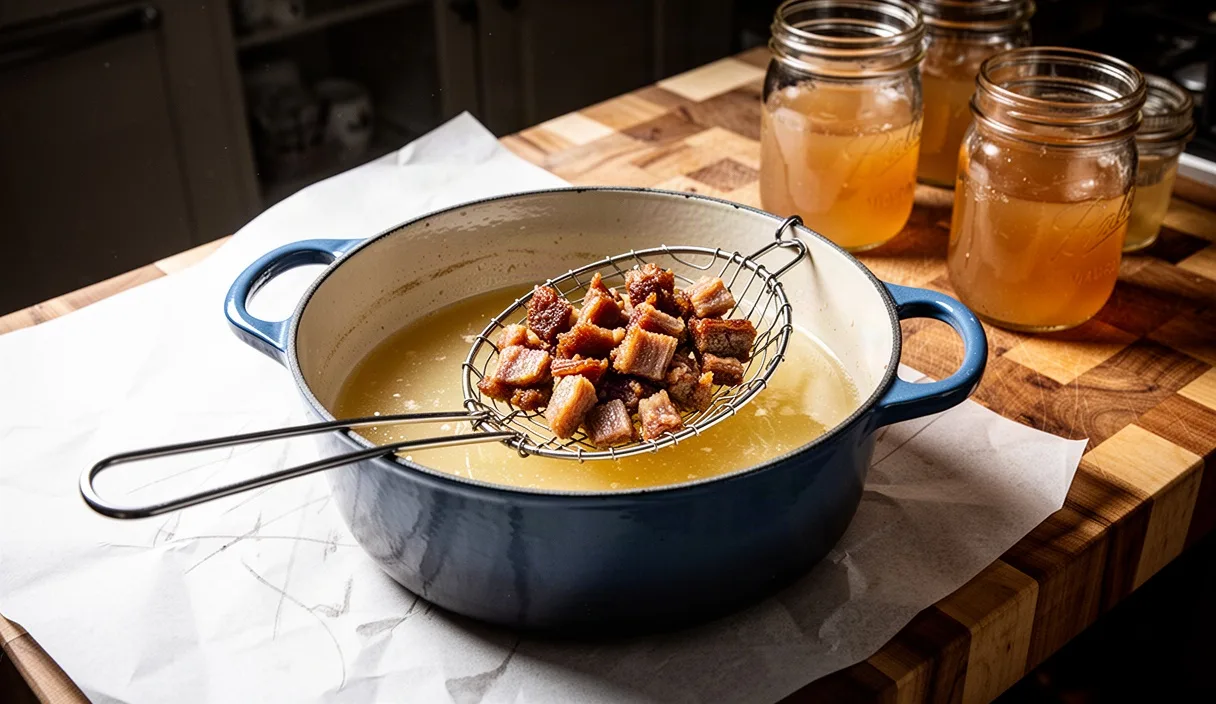
As the extraction progresses into its third and fourth hours, the character of the surface changes. Albumen production ceases, replaced by a layer of rendered yellow chicken fat, known as schmaltz. We leave a moderate film of fat across the surface while the stock simmers; this thin lipid blanket acts as a natural seal against atmospheric oxygen, keeping flavors bright and fresh. Only when the fat layer builds beyond an eighth of an inch do we gently ladle the excess off, saving it in a glass jar in the larder for roasting potatoes or folding into bread doughs.
Straining Through Damp Muslin for Clarity
After five hours of quiet extraction, the bone joints yield entirely to gentle pressure, and the liquid shines with a deep amber clarity. Now we face the critical mechanical separation of liquid from solids. We do not dump the stockpot into a colander. Tipping the contents sends heavy bone fragments crashing into the bottom of the strainer, crushing soft vegetables and forcing micro-particles of debris straight through the mesh into the receiving vessel.
Instead, we prepare a two-tier filtration station. We set a large, fine-wire chinoise or conical sieve over an earthenware crock or a clean stainless steel stockpot. Inside the wire cone, we nest two layers of unbleached cotton cheesecloth or, preferably, tightly woven butter muslin. We wash and wring out the muslin in cold water before draping it inside the sieve. Dry cloth absorbs precious stock and allows floating grease to penetrate the dry fibers immediately; damp fibers swell, forming a tight capillary barrier that lets water slip past while retaining microscopic solids and residual grease.
- Retrieve the large solids: Using a spider skimmer or kitchen tongs, lift out the large carcass frames, cartilage clusters, and softened vegetable segments one by one, letting them drain for three seconds over the pot before discarding them into the compost bucket.
- Ladle the broth: Dip a flat-bottomed ladle into the center of the stockpot, transferring the liquid gently into the center of the damp muslin. Pour from a low height to prevent splashing or mechanical disturbance of the cloth weave.
- Leave the floor sediments: As you reach the bottom two inches of the stockpot, stop ladling. A thick sediment of calcium dust and heavy particulates settles naturally at the very bottom. Discard this muddy residue rather than pouring it through the cloth.
- Avoid pressing: Under no circumstances should you press the remaining bits in the muslin with the back of a spoon. Let gravity pull the clean broth through at its own pace. Pressing extrudes vegetable pulp and clouding agents directly into the clean pan.
The liquor pooling beneath the muslin should be bright, completely transparent, and free of visible floaters. Held to a window, you should see clear, undistorted light through an inch of liquid.
Rapid Cooling Techniques for Larder Storage
Broth rich in gelatin and animal protein represents a prime environment for bacterial expansion between 70 and 120 degrees Fahrenheit. Leaving a five-gallon vessel of hot stock on the counter to cool slowly overnight is a dangerous practice that invites souring and spoilage. Because large bodies of liquid retain core heat for hours, we must drop the temperature of our finished stock below 40 degrees Fahrenheit as rapidly as physics allows.
We use an ice-water bath in a scrubbed stainless steel kitchen sink. We place the collection vessel into the sink basin, elevate its base slightly on a metal wire trivet to permit cold water circulation underneath, and fill the sink with cold water and ice cubes until the waterline reaches level with the stock inside the pot. We drop a clean stem thermometer into the center of the broth and stir the liquid with a sanitized stainless steel paddle every six to eight minutes. Stirring accelerates heat transfer from the core to the chilled walls of the container.
Within thirty to forty-five minutes, the temperature drops from near boiling to under 60 degrees Fahrenheit. At this stage, the stock is safe to portion. We ladle the cool liquid into straight-sided wide-mouth glass jars, leaving at least an inch and a half of headspace below the rim. Water expands as it transitions to ice, and dense gelatin broths will shatter narrow-necked glass containers if filled to the brim. We seal the jars with airtight lids and move them directly into deep refrigeration or the chest freezer.
Common Mistakes to Avoid
A cloudy stock is almost always tracing back to one of four missteps in the kitchen process:
- Allowing the heat to spike: Walking away from the stove during the first forty minutes often leads to an accidental rolling boil, which permanently blends rendered oils into the water.
- Salting the extraction: Never salt stock during the simmering phase. As stock cooks, moisture evaporates; adding salt early risks creating an aggressively brackish base that cannot be reduced down for pan sauces later. Always keep stock completely unseasoned until it enters its final dish.
- Stirring the bottom sediments: Scraping the bottom of the pot with a wooden spoon drags heavy, charred bone particles back into suspension, ruining clarity instantly.
- Using dry or porous filtration cloth: Using cheap, wide-weave grocery store cheesecloth without dampening it allows large flecks of vegetable detritus to pass straight through into your storage jars.
Practical Next Steps for the Pantry
Once your stock has rested in the refrigerator for twelve hours, inspect the top surface. Any trace lipids that escaped the ladle will have solidified into a firm, pale-yellow fat cap. This cap forms an effective protective seal against oxygen. If you intend to use the stock within four to five days, leave this fat cap undisturbed until you are ready to heat the liquid. Lift the hard disk off with a paring knife before decanting the amber jelly underneath.
For longer preservation, divide the cold, jelled stock into half-pint silicone freezing molds. Once frozen solid into compact blocks, pop the stock cubes out and store them in heavy resealable freezer bags. These small, nutrient-dense portions can be retrieved one by one to enrich pan deglazings, loosen cold braises, or steam wild grains. When properly handled, your freezer preserves these frames of savory, clear gelatin for six to nine months without loss of character, ensuring that nothing from your larder is wasted.