When we bring raw suet into our kitchen, we hold the densest, cleanest energy the steer produces. This is not soft trimmings from the brisket or the stringy subcutaneous fat peeled off a flank. True suet is the hard, crumbly visceral fat gathered from around the kidneys and loins. In its raw state, it feels chalky, cool, and waxy against the fingertips, snapping into dry lobes rather than smearing between the fingers. Rendering it transforms this brittle tissue into stable, pale gold tallow that cools to an ivory solid at room temperature.
Making tallow is a quiet exercise in patience and thermal regulation. We rely on rendered fat for frying potatoes, seasoning cast iron skillets, searing steaks, and enriching pastry dough. The process demands that we separate the pure lipids from cellular walls, connective protein fibers, and trace moisture. If we rush and scorch the tissue, the fat carries a barnyard funk and a dingy brown cast. If we undercook and leave water behind, the fat turns rancid or molds inside the jar. Through careful trimming, mechanical mincing, and an initial water buffer, we produce clean, neutral cooking tallow that keeps for months on a dark pantry shelf.
Sourcing and Trimming Firm Suet Around the Kidney
The quality of our rendered fat begins with anatomical selection. We speak directly with a local butcher or abattoir and ask specifically for leaf fat, kidney fat, or visceral suet. Subcutaneous body fat contains a high ratio of unsaturated oleic acid, making it soft, greasy, and prone to oxidation during high-heat cooking. Kidney suet, by contrast, is rich in saturated stearic and palmitic acids. This chemical profile gives the finished tallow a high melting point, hovering near 113 to 118 degrees Fahrenheit, which produces crispness in fried foods without greasy residue.
Raw suet arrives wrapped around the organs, often encased in a paper-thin connective membrane known as the perinephric tunic. Before rendering, we lay the cold lobes on a heavy wooden cutting board and inspect every fold. We peel away this outer skin with a sharp boning knife. The membrane will not melt; if left in the kettle, it tightens into tough sheets that trap raw fat inside and scorch against the bottom of the pot.
We also inspect the suet for small blood vessels, red spots, and traces of kidney tissue. Any red hemoglobin left in the mix will oxidize under heat, imparting a metallic bitterness and muddying the ivory color of our tallow. We cut away every sliver of red muscle and discard any sections stained with bile or fluid. What remains should look like pristine, dry white chalk with a faint, clean scent reminiscent of fresh sweet cream.
| Fat Type | Anatomical Origin | Physical Texture | Best Culinary Application |
|---|---|---|---|
| Leaf Suet | Perinephric (around kidneys) | Firm, brittle, dry, crumbly | High-heat frying, pie crusts, soap making |
| Subcutaneous Fat | Outer carcass layer (back, brisket) | Soft, oily, elastic, pliable | Sausage grinds, burger blends, braising |
| Intermuscular Fat | Seams between muscle groups | Spongy, webbed with collagen | Slow broths, ground meat enrichment |
Chilling and Grinding Fat for Fast Extraction
Fat renders from the outside inward. If we drop large chunks of suet into a hot pot, the exterior crisps and forms a waterproof, rubbery crust before the core reaches rendering temperature. This traps liquid fat inside, forcing us to cook the pot longer and hotter, which degrades the clean flavor of the lipid. To ensure fast, even release, we reduce the suet to small, uniform granules before applying heat.
Warm fat is gummy and clings stubbornly to knife blades and grinder plates. We place our trimmed suet into the freezer for 35 to 45 minutes until the exterior feels firm and icy, though not frozen solid. If we are using an electric or manual meat grinder, we run the metal auger, throat, and cutting dies through the freezer alongside the fat. Chilled equipment prevents friction heat, which causes fat to smear into a paste that clogs the grinder plate.
We push the firm chunks through an eight-millimeter coarse plate. The cold suet exits the grinder looking like coarse grains of white rice. If a meat grinder is unavailable, we use a heavy chef knife to hand-dice the suet into cubes measuring no larger than a quarter of an inch. Dicing takes roughly three times longer than grinding, but fine pieces ensure that the cell walls rupture promptly once heat touches the pot.
The Wet Render Method: Using Water as Heat Buffer
Dry rendering exposes raw ground fat directly to the dry metal base of the pan. Even on the lowest burner setting, hot spots occur, caramelizing the fine protein particles and turning the fat gray or yellow. We prefer the wet render method, which uses liquid water as a protective thermal blanket during the initial breakdown.
We place our ground suet into a heavy, enamel-coated cast iron Dutch oven or a thick stainless steel stockpot. For every five pounds of prepared suet, we pour in approximately one cup of cold water. We set the burner to medium-low. At this stage, the water conducts heat gently around each granule, keeping the bottom temperature locked at or below 212 degrees Fahrenheit while the fat begins to melt out of its cellular pockets.
Within twenty minutes, the water turns cloudy and milky as fat emulsifies into the liquid. We stir the pot every ten minutes with a broad wooden paddle, scraping the bottom to prevent loose connective bits from settling. As more fat liquefies, the granules shrink into pale, floating specks. The water prevents scorching while the bulk of the cellular fat pours out into the kettle.
- Target kettle temperature during wet extraction: 195 to 210 degrees Fahrenheit.
- Pot material: Enameled cast iron or tri-ply stainless steel; avoid raw aluminum, which can react and discolor the tallow.
- Stirring frequency: Every 8 to 12 minutes to keep loose membranes suspended.
Evaporating Residual Water to Guarantee Shelf Life
Water is the enemy of stored fat. Bacteria and fungal spores cannot grow in pure lipids, but a micro-droplet of trapped moisture creates an environment where mold thrives and hydrolytic rancidity begins. Once the suet granules have yielded their fat, our task shifts from extraction to moisture removal.
As the render progresses past the two-hour mark, the pot begins to simmer audibly. This bubbling is not the fat boiling; pure tallow boils at temperatures well above 400 degrees Fahrenheit. The bubbles are water converting into steam and escaping upward through the fat layer. During this phase, the surface shows a rolling, frothy foam, and the fat looks slightly cloudy due to suspended steam micro-bubbles.
We maintain the heat so the kettle registers between 225 and 235 degrees Fahrenheit. We listen carefully. As the water volume diminishes, the violent foaming subsides into tiny, quiet pin-prick bubbles. When the steam ceases entirely and the liquid turns clear as liquid gold, we know the water has fully evaporated. The cracklings, now composed of dehydrated protein and collagen, will turn a light straw color and sink toward the bottom of the pot. We pull the pot from the burner immediately to prevent these browned bits from toasting further.
Filtering Hot Tallow Through Layered Cheesecloth
Removing suspended particulate matter guarantees that the finished tallow cools to a clean white disk without a gray layer of sediment at the bottom. We prepare our filtration station while the fat is hot, because tallow thickens rapidly as it drops below 130 degrees Fahrenheit, which slows drainage and clogs the filter cloth.
We set a wide stainless steel funnel inside the mouth of a clean, dry, heat-safe vessel, such as a large Pyrex measuring pitcher or a collection pot. Inside the funnel, we lay four layers of unbleached Grade 90 cotton cheesecloth. Alternatively, we use an unbleached conical coffee filter or a dedicated felt oil filtering cone. We avoid bleached paper towels, which can tear under the weight of hot fat and release chemical residues or loose cellulose fibers into the oil.
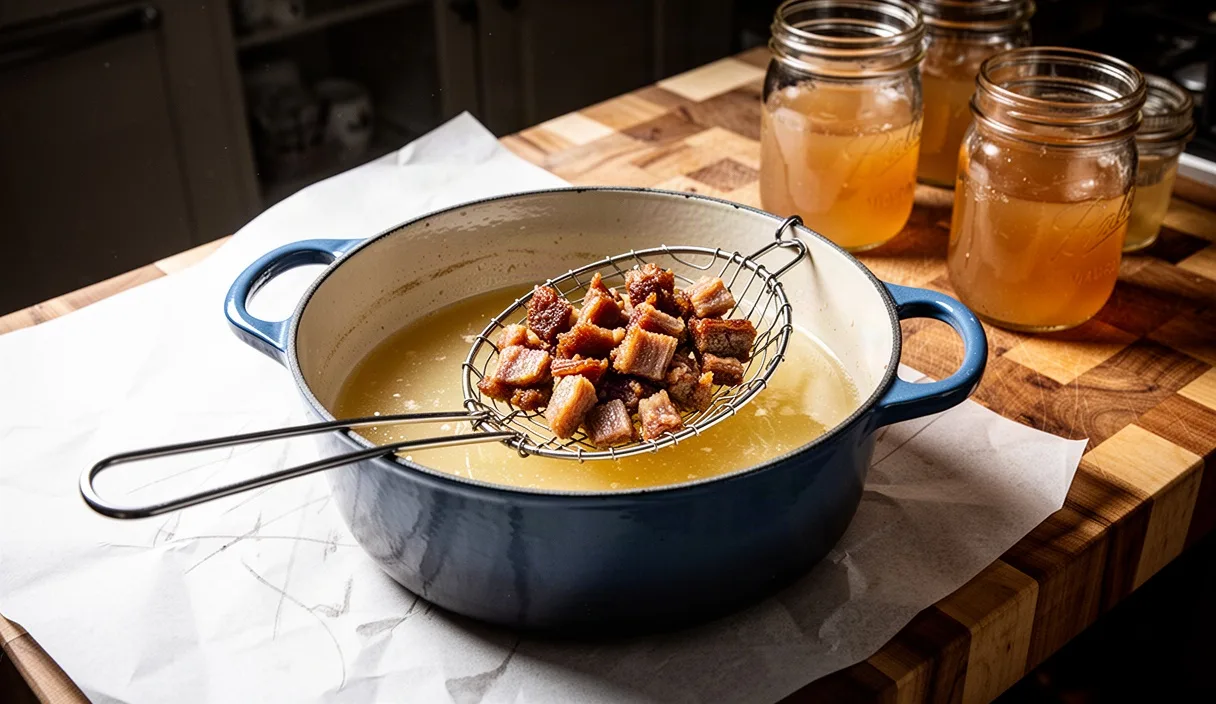
Using a long-handled stainless steel ladle, we skim the largest floating cracklings from the pot and transfer them to a plate lined with butcher paper; these can be salted and eaten as a crisp kitchen snack. Next, we pour the liquid fat slowly through our prepared filter. We resist the temptation to squeeze the cloth with tongs or a spoon. Squeezing forces microscopic protein paste through the weave, which muddies the liquid and shortens the shelf life of the tallow. We let gravity do the work, allowing the amber stream to collect cleanly beneath.
- Allow the rendered pot to rest off the flame for seven minutes to settle heavy sediment.
- Pre-warm your glass or ceramic collection jars with warm water, drying them thoroughly, to prevent thermal shock from hot oil.
- Ladle the hot fat through the multi-layered filter without pressing down on the sediment.
- Stop pouring when the cloudy, sludge-heavy dregs at the very bottom of the pot reach the funnel lip.
Casting, Solidifying, and Storing the Finished Fat
The cooling phase determines the crystalline structure and final texture of the tallow. If tallow cools too slowly in an insulated, hot room, large stearic crystals form, giving the fat a grainy, crumbly mouthfeel. If it cools at a steady, moderate pace, it forms a tight, velvety crystalline matrix that scoops smoothly under a spoon.
We pour the warm, filtered liquid into wide-mouth glass mason jars or silicone block molds, leaving a half-inch of headspace at the top. We leave the lids off while the fat is warm. Placing a sealed lid on a jar of hot tallow causes condensation to form on the underside of the metal, which drips pure water back down onto the fat, creating a pocket for spoilage. We cover the mouth loosely with a clean linen cloth to keep dust away while allowing vapors to escape.
We place the cooling jars on a wire rack on the countertop away from drafts. As the fat drops to room temperature, the amber liquid clouds, pales, and sets into a dense, solid block resembling paraffin wax. Once it is cool to the touch, we screw on an airtight lid. Properly rendered, moisture-free kidney tallow keeps on a dark, cool pantry shelf for six to nine months, in a refrigerator for over a year, or in the freezer for two years or longer without losing its clean, sweet profile.
Common mistakes
The most frequent failure in tallow rendering is applying excessive heat too early. High heat scorches the fragile proteins before the fat has left the cells, leaving you with brown, pungent fat that tastes like fried meat rather than a neutral cooking medium. Keep your burner low, especially during the first hour of rendering.
Another common mistake is rushing the water evaporation step. If you bottle the fat while fine steam bubbles are still emerging, you are bottling moisture. That water inevitably pools at the base of the jar, creating an anaerobic pocket where bacteria multiply, turning your hard work rancid within weeks. Listen for the silence in the pot: silence means the water is gone.
Lastly, do not skip thorough trimming. Many beginners leave the outer perinephric skin or patches of red flesh on the suet, thinking the filter will catch it later. While the cloth does catch the solids, the compounds in blood and glandular tissue dissolve directly into the warm lipids, permanently tinting the fat and giving it a sour smell that no amount of filtering can remove.
Next Steps for Your Larder
Once your tallow has set firm and pale in its jars, test a small spoonful in a warm skillet. It should melt quietly without aggressive spattering, which proves you successfully drove out all residual water. The aroma should be faint, rich, and clean, with no trace of acrid smoke or sourness.
Label your jars with the rendering date and the source of the suet. Keep one jar beside the hearth or stove for daily cooking, and stash the remainder in your coldest storage area away from direct sunlight. When you are comfortable with this basic technique, you can explore clarifying the fat with a salt-water wash to create odorless tallow suitable for natural balms and tallow soap.