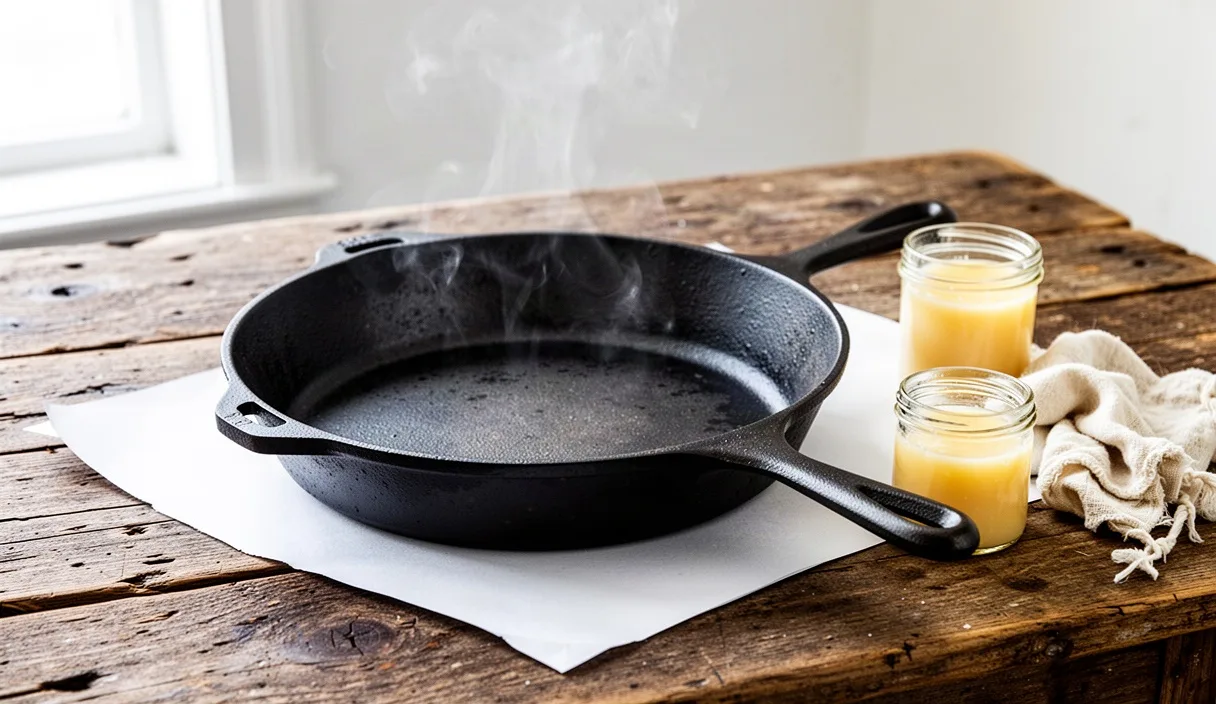
Bare cast iron has an honest, utilitarian presence on the workbench. In its raw form, straight from the foundry or freshly stripped of decades of crust, it carries a matte gray hue, a coarse tooth, and a faint metallic scent. The metal is porous and hungry for moisture, which makes it prone to rapid oxidation if left exposed to ambient humidity. When we take on the restoration of a bare skillet, we are participating in a craft that relies on heat, surface geometry, and the chemical transformation of lipids into a hard, protective polymer.
The protective shield we build on cast iron is not merely a coat of grease. It is a glassy, insoluble film created through thermal polymerization and cross-linking. In our kitchen workshop, we look closely at two distinct fat bases: cold-pressed flaxseed oil, a drying oil rich in polyunsaturated fatty acids, and rendered beef tallow, a traditional saturated fat with deep historical roots. Each material handles differently under heat, forms a distinct crystalline lattice, and demands exact surface preparation to bond permanently to the iron substrate.
Stripping Old Coatings and Rust from the Pan
Before any new layer of seasoning can anchor itself to the iron, we must clear away every trace of degraded grease, carbonized food, and ferric oxide. Applying fresh oil over old, flaking carbon creates an unstable foundation that will peel under the scrape of a metal spatula. We begin by diagnosing what sits on the surface: rust requires an acid reduction, while carbonized grease demands an alkaline bath.
To dissolve old seasoning without removing virgin metal, we submerge the skillet in a lye bath. We mix 1 pound of pure sodium hydroxide crystals into 5 gallons of cold water in a heavy-duty plastic container, always adding the crystals to the water to prevent violent splashing. After 48 hours submerged, the old organic buildup turns into a soft sludge that washes away under running water with a stiff nylon brush. If lye is unavailable, an oven cleaner containing sodium hydroxide sprayed liberally inside a sealed heavy garbage bag for two days will soften stubborn layers.
For surface rust, we use an acid solution mixed at an exact ratio: 1 part 5-percent distilled white vinegar to 1 part cold tap water. We submerge the rusted pan for no longer than 35 minutes at a stretch. Leaving iron in vinegar for extended periods will etch the metal, creating deep pitting that weakens the casting. Once the rust loosens, we scrub the piece aggressively using grade 00 steel wool, rinse it thoroughly in cold water, and dry it immediately with clean shop rags.
Flash rust will appear within minutes on raw iron. To halt this immediate oxidation, we place the scrubbed pan directly into a warm oven preheated to 200 degrees Fahrenheit. The dry heat drives off capillary moisture from the pores of the iron, stabilizing the metal while we prepare our fat source.
Selecting Between Vegetable Drying Oils and Animal Fats
The choice between flaxseed oil and rendered beef tallow divides cooks and restorers along chemical lines. Flaxseed oil is an edible cousin of boiled linseed oil, prized for its high content of alpha-linolenic acid. When exposed to high heat in the presence of oxygen, its multiple carbon-carbon double bonds crack, form free radicals, and cross-link into a rigid, amber-tinted film. Beef tallow, by contrast, consists largely of saturated and monounsaturated fatty acids like palmitic, stearic, and oleic acids. It creates a more flexible, shock-resistant coating that resists chipping.
When choosing flaxseed oil, we buy exclusively organic, cold-pressed, unfiltered oil from a refrigerated display case. Shelf-stable flaxseed oils often contain chemical stabilizers, while hardware-store boiled linseed oil contains toxic heavy-metal drying agents like cobalt and manganese that must never touch a cookware surface. For tallow, we render suet from grass-fed beef, simmering it gently over low heat until the water evaporates and straining it through four layers of cheesecloth until the fat cools into a pure white, solid block free of protein solids.
| Characteristic | Organic Flaxseed Oil | Rendered Beef Tallow |
|---|---|---|
| Predominant Fatty Acids | Polyunsaturated (Alpha-Linolenic) | Saturated and Monounsaturated |
| Smoke Point | 225 degrees Fahrenheit | 400 degrees Fahrenheit |
| Film Structure | Hard, glassy, rigid | Tough, flexible, waxy |
| Wear Behavior | Can micro-flake if applied too thick | Gradually wears down rather than chipping |
| Initial Color | Golden amber to dark brown | Rich slate gray to soft black |
We often use both in our work, depending on the tool. A display pan or a bread pan that sees light abrasive contact benefits from the glassy smoothness of flaxseed. A daily skillet destined for campfire embers, high-heat searing, and scraping with sharp metal spatulas holds up better under the dense, flexible lattice of beef tallow.
Wiping the Iron until It Appears Dry
The most common failure in seasoning cast iron is excess fat. If an oily liquid pools on the surface as it enters the hot oven, it does not polymerize into a smooth sheet. Instead, it bubbles, contracts, and forms a tacky, mottled snakeskin pattern that feels sticky to the touch and must be scrubbed off with solvent or lye. The goal is to lay down an oil film measured in microns.
We remove the warmed skillet from the 200-degree oven using heavy leather gloves. At this temperature, the pores of the iron have expanded slightly, and any residual surface moisture has evaporated. We place a half-teaspoon dollop of solid tallow or liquid flaxseed oil directly into the center of the pan. Using a clean piece of unbleached cotton cloth or a blue shop towel, we spread the fat over every surface: the cooking floor, the interior walls, the lip, the exterior base, and the handle.
Next comes the critical manual step. We take a fresh, completely dry cotton cloth and wipe the pan as if we applied the oil by mistake and are trying to remove every trace of it. We rub the skillet hard, flipping the cloth repeatedly to a clean side. When finished, the cast iron should show no wet sheen, no droplet lines, and no greasy residue. It should look dry and matte, with only a dull satin glow visible under direct workshop light. This leaves a micro-layer thin enough to polymerize completely without bubbling.
Setting Oven Temperature for Proper Polymerization
Polymerization requires pushing the applied lipid past its smoke point so that the fatty acid molecules break down, bond with atmospheric oxygen, and fuse to the iron substrate. If the oven temperature is too low, the oil merely bakes into a tacky sludge. If the temperature is far too high, the fat burns off entirely into white ash, leaving the iron bare once again.
For flaxseed oil, we place the wiped skillet upside down on the middle rack of a cold oven. We place a wide baking sheet lined with aluminum foil on the lower rack to catch any rogue drips, though a properly wiped pan will not drip. We set the oven to 450 degrees Fahrenheit. As the temperature climbs past the 225-degree smoke point of the unrefined oil, thermal cracking initiates. We hold the oven at 450 degrees for an hour and 15 minutes, ensuring the exhaust fan runs to carry away the sharp, pungent vapors.
For beef tallow, we follow the same physical placement but adjust the thermal profile. Because rendered tallow has a smoke point around 400 degrees Fahrenheit, we set the oven temperature to 425 degrees Fahrenheit. We let the pan bake at this temperature for 75 minutes. At this threshold, the triglycerides degrade cleanly, building a resilient carbon matrix directly on the crystalline face of the iron.
Cooling and Repeating for Multi-Layer Hardness
Thermal patience is vital during the cooling phase. Rapid cooling stresses both the iron casting and the newly formed polymer layer. Cast iron contains a high percentage of carbon, which makes it brittle and vulnerable to thermal shock; pulling a 450-degree pan out into a cool 68-degree room can crack the casting along invisible grain lines.
When the baking timer expires, we turn off the oven and leave the door shut. We allow the iron to cool down slowly inside the oven cavity for two to three hours until the skillet handles can be held barehanded. As the metal contracts gradually, the newly formed polymer settles into the microscopic valleys of the casting, hardening into place without micro-fracturing.
A single pass produces a functional rust barrier, but it does not produce a durable cooking surface. We build our patina across four distinct cycles: warm the pan, apply the fat, wipe it dry, bake it hot, and cool it slowly.
- Heat the pan to 200 degrees Fahrenheit to open the pores and ensure dryness.
- Work a scant half-teaspoon of fat across all surfaces using a cotton rag.
- Buff the pan vigorously with a second dry rag until the iron looks matte.
- Bake inverted at 450 degrees for flaxseed, or 425 degrees for tallow, for 75 minutes.
- Turn off the heat and let the iron cool completely inside the closed oven.
- Inspect the sheen, then repeat the entire cycle three more times.
By the end of the fourth round, the skillet will have shifted from flat charcoal gray to an even, semi-gloss bronze-black. The surface will feel dry and slick under the thumb, ready to accept regular kitchen use.
Spot Repairs for Common Acid Burns
Even a well-cured skillet can suffer damage from kitchen mishaps. Deglazing with acidic liquids like dry wine, simmering whole peeled tomatoes, or leaving lemon wedges in the skillet can strip the polymer film down to raw iron in a matter of minutes. When an acid burn occurs, it is not necessary to submerge the entire skillet in a lye bath and start over from scratch.
We treat localized damage with a quick stovetop spot repair. First, we take grade 0 steel wool and water, scrubbing directly over the damaged patch to feather the edges where the bare metal meets the intact seasoning. This removes any loose polymer scales and creates a gradual transition. We rinse and dry the pan, then set it over a gas burner on medium-low heat until the entire surface is uniformly hot.
Using tongs wrapped in a clean cotton rag, we dip into our tallow or flaxseed oil and wipe a thin film over the bare patch. We immediately take a second rag and buff it down until the spot looks dry. As the burner heat brings the iron up past the smoke point, small wisps of blue smoke will drift off the pan. We let it smoke for 60 seconds, wipe it again with the dry rag, and apply another micro-drop of fat. Repeating this stovetop cycle three times in twenty minutes will blend the damaged spot back into the surrounding patina, restoring rust protection without a full oven cycle.
Common Mistakes
Restoring and seasoning iron requires attention to detail. We frequently see pans compromised by small oversights in technique:
- Over-applying the fat: Leaving visible liquid on the surface causes a sticky, gummy residue that catches food and turns rancid. Always wipe until the pan appears bone dry before heating.
- Rushing the chemical strip: Leaving patches of old, crusty seasoning on the sidewalls causes the new layers to lift off later. The iron must be completely stripped to the raw gray metal for a permanent bond.
- Over-soaking in vinegar: Leaving raw iron in an acid bath overnight eats away the soft ferrite matrix of the metal, leaving a rough, permanently pitted texture that no amount of oil can smooth out.
- Inadequate ventilation: Polymerizing oil produces acrolein and other airborne irritants. Failing to run an exhaust hood or open windows will fill the living space with dense, eye-watering smoke.
- Using unrendered fats: Using raw animal fat, salted butter, or unclarified bacon grease introduces moisture, salt, and milk solids that burn into bitter carbon rather than cross-linking into a polymer.
Next Steps for the Hearth and Kitchen
With four thin coats locked onto your skillet, the iron is chemically protected, but the seasoning remains young and tender. The first twelve meals cooked in the pan will determine its long-term performance. We reserve this early stage for tasks that gently deposit carbon and fat without abrasive friction.
For the first month of use, focus on frying potatoes in beef fat, baking round loaves of sourdough bread, searing bone-in pork chops, and roasting root vegetables tossed in oil. Keep acidic foods, sweet barbecue marinades, and boiled water dishes out of the pan until the patina turns deep black and mirror-smooth.
After each use, clean the iron promptly with warm tap water and a stiff horsehair brush. Dish soap may be used freely; properly polymerized oil is a durable plastic-like material that soap molecules cannot break down. Avoid abrasive scrubbing pads made of green nylon, dry the pan over a low stovetop flame for three minutes, and rub a drop of tallow into the warm surface before hanging it back on the wall rack.